
Aligarh Muslim University is not a minority educational institution, Supreme Court's Justice Dipankar Datta said on Friday and noted had it not been a "race against time" he would have articulated better in his dissenting opinion. The judge also flagged a non-exchange of ideas and opinions in a "true democratic spirit" to build a consensus.
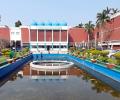
The Supreme Court on Friday deferred the question of Aligarh Muslim University's minority status to a fresh bench and overruled the 1967 judgment that said the university cannot be considered a minority institution since it was created by a central law.
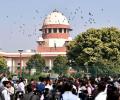
Chief Justice of India D Y Chandrachud has constituted an all-woman bench comprising Justices Hima Kohli and Bela M Trivedi to hear transfer petitions involving matrimonial disputes and bail matters on Thursday.

The Supreme Court on Thursday upheld the constitutional validity of Section 6A of the Citizenship Act related to the grant of Indian citizenship to illegal immigrants in Assam by a majority verdict of 4:1.

The Supreme Court on Friday held that the Prohibition of Child Marriage Act cannot be stunted by personal laws and that marriages involving children violate the free will to have a life partner of choice.

Merely because an educational institution is regulated by a statute does not take away from it the character of a minority institution, the Supreme Court observed on Tuesday as it commenced hearing the vexed question of minority status of Aligarh Muslim University (AMU).
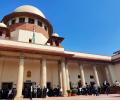
A seven-judge Constitution bench comprising Chief Justice DY Chandrachud and Justices BR Gavai, Vikram Nath, Bela Trivedi, Pankaj Mithal, Manoj Misra and Satish Chandra Sharma said there is no error apparent on the face of the record.
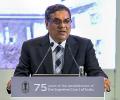
Justice Sanjiv Khanna 'belongs to that school of legal luminaries who give the highest primacy to facts.'
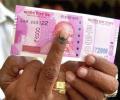
Following is the chronology of events in the case related to validity of the electoral bonds scheme, a mode of funding to political parties, in which a five-judge Constitution bench of the Supreme Court on Thursday delivered a landmark verdict annulling it.

Observing secularism means to 'live and let live', the Supreme Court on Tuesday said regulating madrasas was in the national interest as several hundred years of the nation's composite culture could not be wished away by creating silos for minorities.

The letter comes after a report by the London-based Financial Times, citing documents from George Soros-backed Organized Crime and Corruption Reporting Project (OCCRP), alluded to a "fraud" by the Adani Group by selling low-grade coal as high-value fuel in 2013.
A seven-judge Constitution bench headed by Chief Justice D Y Chandrachud, by a majority of 6:1, set aside the apex court's five-judge bench verdict of 2014 in the EV Chinnaiah vs State of Andhra Pradesh case which had held that no sub-classification of Scheduled Castes (SCs) can be allowed as they are a homogeneous class in themselves.

The top court, meanwhile, permitted the state government to amend its plea to seek issuance of guidelines for the governors on grant or decline of assent to the bills passed by the assembly in a time-bound manner.

The Supreme Court on Thursday set aside caste-based discriminatory provisions of prison manuals of around 11 states while deprecating the practice of distribution of work and segregation of prisoners in separate wards on basis of their castes.

The Supreme Court on Wednesday asked whether Parliament could have enacted the Jammu and Kashmir Reorganisation Act, which divided the erstwhile state into two Union territories, during the subsistence of President's rule in 2018-2019.
The Collegium's recommendations, if accepted by the Centre, will raise the total number of judges in the apex court to 33 against the sanctioned strength of 34 including the CJI.
In a significant verdict, the Supreme Court by a majority of 7:2 on Tuesday held all private properties cannot form part of "material resources of the community" empowering states to take them over for distribution to serve "common good" under the Constitution.
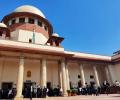
Tewari, a Congress leader and Lok Sabha MP, was appearing for former Arunachal Pradesh MLA Padi Richo, who has filed an intervention application in a batch of petitions challenging abrogation of Article 370.

The Supreme Court on Friday directed the Tamil Nadu government not to shift YouTuber Manish Kashyap, arrested for allegedly circulating fake videos of migrant labourers being attacked in the southern state, from the Madurai central prison.

They all assembled at the judges' lounge before the start of the day's work and gave a standing ovation to Pragya, daughter of an obscure cook at the top court Ajay Kumar Samal.

Creating a record, the CJI headed apex court collegium meetings led to appointment of 11 Supreme Court judges with nine of them, including three women, appointed in one go.

Non-heterosexual unions and heterosexual marriages ought to be considered as two sides of the same coin, both in terms of recognition and consequential benefits, Supreme Court judge Justice Sanjay Kishan Kaul said as he lamented that the only deficiency at present is the absence of a suitable regulatory framework for such unions.

CJI Lalit concurred with the minority view of Justice S Ravindra Bhat who held the EWS quota as "unconstitutional" for excluding poor among SCs, STs and OBCs.

The judge further underlined that the minorities of the country had not only joined the mainstream but also were an important facet of it.
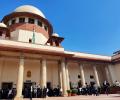
A committee headed by Chief Justice of India DY Chandrachud designated 56 lawyers and advocate-on-record as senior advocates, 11 of them women.
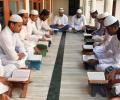
Commencing final arguments on a batch of pleas against the verdict, the bench, heard senior lawyers including Abhishek Manu Singhvi, Salman Khursheed and Menaka Guruswamy for the petitioners.

Over 260 eminent citizens, including former judges and bureaucrats, have written to Chief Justice of India D Y Chandrachud urging him to take cognisance of DMK leader Udhayanidhi Stalin's 'eradicate Sanatan Dharma' comment, calling it "hate speech".
The electoral bonds scheme for funding political parties should not become a tool for "legitimisation of quid pro quo" between power centres and people who are benefactors of that power, the Supreme Court said on Thursday as it underscored the need for reducing the cash component in the electoral process.

A bench comprising Justices Sanjiv Khanna, M M Sundresh and Bela M Trivedi will hear the plea of jailed JMM leader at 10.30 am on Friday.
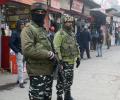
The Supreme Court on Monday ruled the former state of Jammu and Kashmir did not have any 'internal sovereignty' that was distinguishable from the powers and privileges enjoyed by other states in the country.
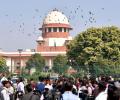
Besides the CJI, the seniormost judge, Justice N V Ramana, and justices R F Nariman, U U Lalit, A M Khanwilkar, D Y Chandrachud, Ashok Bhushan and L Nageswara Rao would deal with the PILs and social justice matters, usually involving the Centre and the states, and their instrumentalities as opposite parties.
Allowing the Centre's review of the August 23, 2022 verdict, a bench Chief Justice of India DY Chandrachud, Justices PS Narasimha and Manoj Misra recalled the judgement delivered by a three-judge bench headed by former CJI NV Ramana.

National Conference leader Mohammed Akbar Lone on Tuesday filed an affidavit in the Supreme Court reiterating his oath as Lok Sabha MP, saying he will preserve and uphold the Constitution and protect the country's territorial integrity, an undertaking that irked the Centre which claimed it added "insult to injury to the nation".
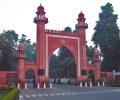
The mere fact that some part of administration of an educational institution is also looked after by non-minority officials does not "dilute" its minority character, the Supreme Court observed on Wednesday while hearing the hugely disputed minority status of Aligarh Muslim University (AMU).
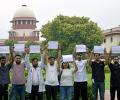
The Supreme Court on Tuesday dismissed the pleas seeking cancellation and re-test of the controversy-ridden National Eligibility-cum-Entrance Test-Undergraduate (NEET-UG) 2024, holding that there was no data on record to indicate a systemic leak of question paper and other malpractices.

The Supreme Court on Tuesday termed as "unacceptable" the submission that Article 370 of the Constitution ceased to operate once the term of the constituent assembly of Jammu and Kashmir ended in 1957 after drafting the state's constitution.

Democracy does not begin and end with elections and the integrity of election process is pivotal for sustaining the democratic form of government, the Supreme Court said on Thursday while striking down as unconstitutional the electoral bonds scheme for political funding.
The apex court termed the prevalence of "social evil" of child marriage as "sobering" and passed a slew of directions to the Centre, states, district administrations, panchayats and the judiciary to eradicate the malaise.

The bench wondered if it struck down the immunity clause in the penal codes then the offence will be covered under the main provision on rape or "can the court create a separate offence or adjudicate the validity of the exception (clause)".

The former woman employee of the apex court, who has levelled the sexual harassment allegations, has opted herself out from participating in the enquiry.
